German company sleeve
Telefunken “Künstler von Weltruf” artist sleeve
A Telefunken sleeve from a series of artist portraits, with Karl Schmitt-Walter on one side and Peter Kreuder on the other.
Dating at a glance
- Printed
- 1938–1939
most likely 1938 - In use
- 1938–39; possibly still in use in 1940
- Confidence
- Medium-high
- Basis
- The artists named on the sleeve: when they joined Telefunken, and who could still be praised on a German sleeve
The sleeve
Every edge carries the line KÜNSTLER VON WELTRUF AUF TELEFUNKENPLATTEN
(“world-famous artists on Telefunken records”), with the diamond Telefunken logo in the corners and a large roundel lettered TELEFUNKENPLATTEN
. One side has a portrait of the baritone Karl Schmitt-Walter in opera costume and a short appreciation. The other has the composer and pianist Peter Kreuder and a list headed Sie hören ferner auf Telefunkenplatten:
(“You can also hear on Telefunken records:”).
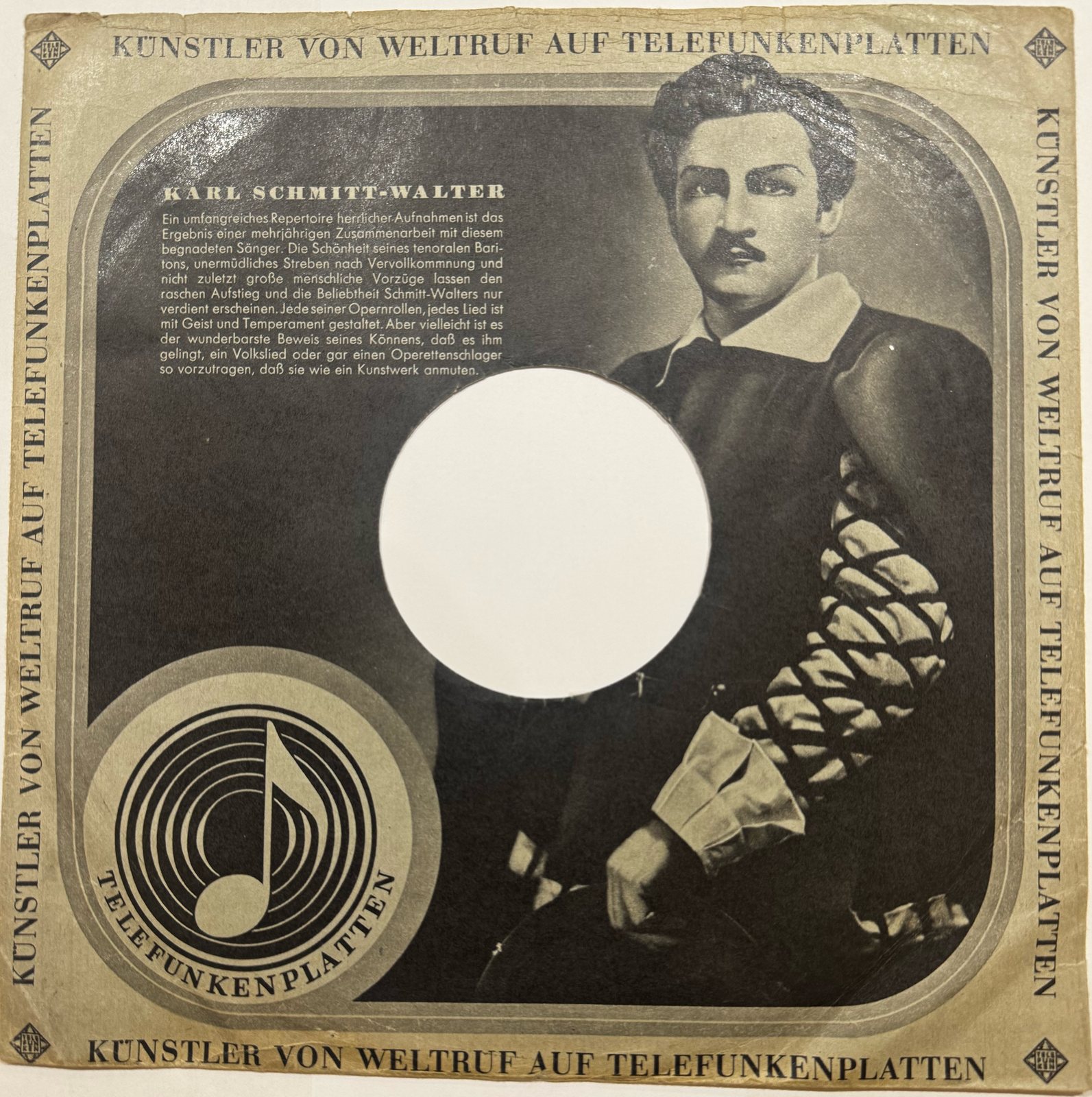
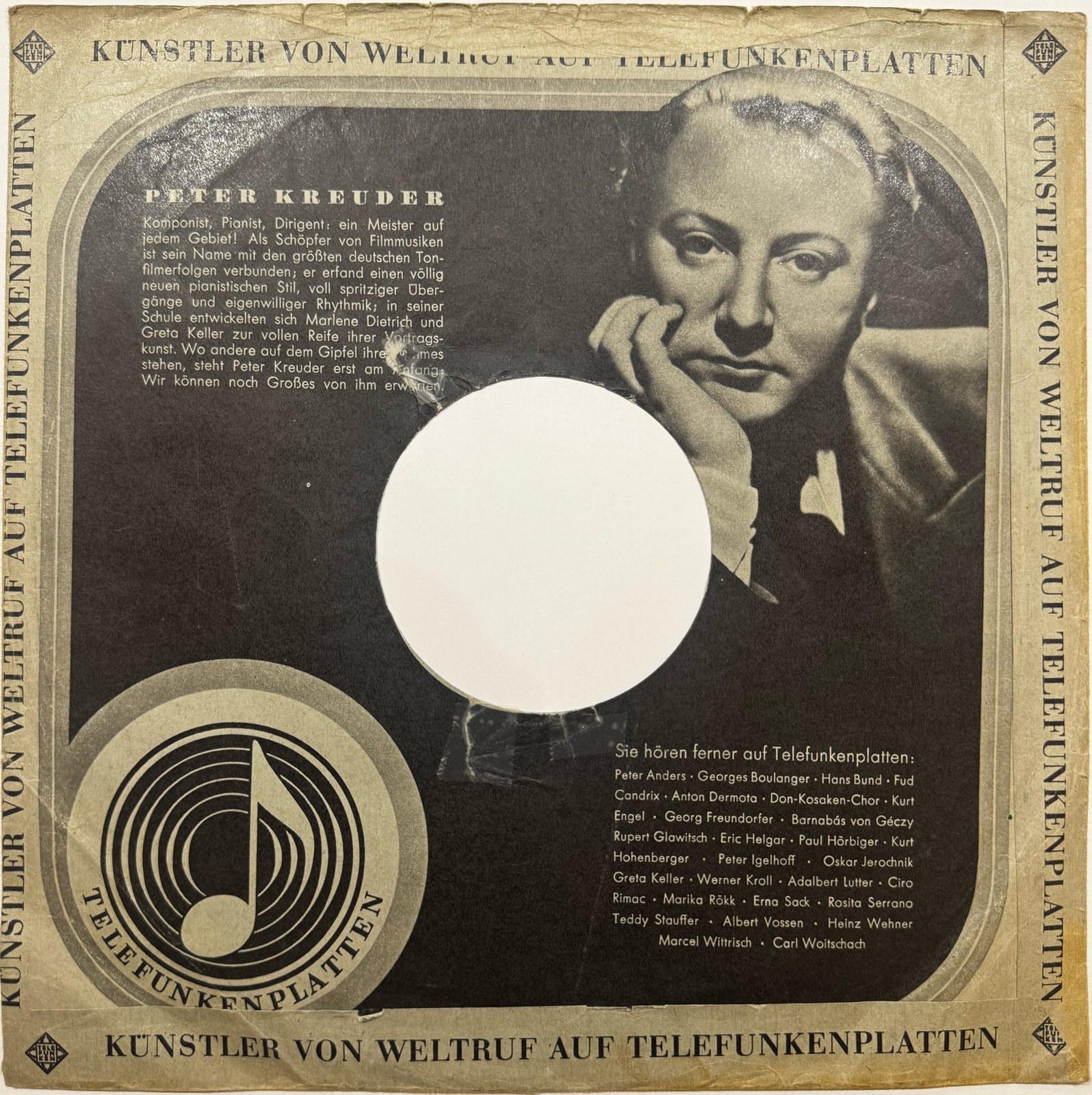
The artists listed on side B
Peter Anders · Georges Boulanger · Hans Bund · Fud Candrix · Anton Dermota · Don-Kosaken-Chor · Kurt Engel · Georg Freundorfer · Barnabás von Géczy · Rupert Glawitsch · Eric Helgar · Paul Hörbiger · Kurt Hohenberger · Peter Igelhoff · Oskar Jerochnik · Greta Keller · Werner Kroll · Adalbert Lutter · Ciro Rimac · Marika Rökk · Erna Sack · Rosita Serrano · Teddy Stauffer · Albert Vossen · Heinz Wehner · Marcel Wittrisch · Carl Woitschach
The evidence
- ObservedA series of portrait sleeves. Phonopassion, a German dealer, lists the same design as “Telefunken_31”, matching on both sides. A sister sleeve, “Telefunken_33”, shows Erna Sack, Peter Anders, Rosita Serrano and Teddy Stauffer. Phonopassion gives no date.
- DocumentedNot before 1938. Rosita Serrano’s first Telefunken records (A 2480 and A 2481) are dated 1938, and her Roter Mohn (A 2702) was recorded in October 1938.
- DocumentedConsistent with late 1937 or later. Fud Candrix’s Telefunken recordings start in late 1937, for example Cotton Picker’s Congregation on 25 November 1937.
- InferredProbably not after about 1939. The Kreuder text praises Greta Keller and Marlene Dietrich as singers who matured in his school. Keller’s last European recording period ended in 1938, after which she moved to the USA. Dietrich refused to return to Germany and became a US citizen in 1939, and praising her on a German sleeve becomes very unlikely after that. Teddy Stauffer’s Telefunken period in Germany also ended in 1939.
- InferredEarly in Kreuder’s fame. The text says Kreuder is
erst am Anfang
(“only at the beginning”), which fits the late 1930s. - InferredUse after printing. Sleeve stock was often used up for a year or two, so a record bought in 1940 could still have come in this sleeve.
Sources
- Phonopassion sleeve type Telefunken_31 (same design; image): https://phonopassion.de/images/cover/telefunken_31.jpg
- Phonopassion sleeve type Telefunken_33 (sister design; image): https://phonopassion.de/images/cover/telefunken_33.jpg
- Rosita Serrano discography, vongeczy.beepworld.de: https://vongeczy.beepworld.de/serrano.htm
- Fud Candrix Telefunken recordings (PDF), grammophon-platten.de: https://grammophon-platten.de/e107_files/public/1389943980_179_FT0_fud.candrix.pdf
- Wikipedia, Greta Keller: https://en.wikipedia.org/wiki/Greta_Keller


Uncertainty
No source dates this sleeve directly. The window comes from the artists it names, and the upper limit depends on our reasoning about Keller, Dietrich and Stauffer rather than on a dated example. We have not found the sleeve with a dated Telefunken record.
Researched 2 November 2026. Photographs replaced on 12 November 2026: Simon photographed the sleeve again, empty and flat. We have not established whether this is the same copy he photographed on 2 November or a second one. The dating is unchanged.